DAIKIN Air Conditioning DX, VRV & Chiller Systems Explained
If you’ve lived in the UAE through a full summer, you already know that “air conditioning” here isn’t a comfort feature — it’s infrastructure. On August 5, 2025, the mercury hit 51.2°C in Budu Dafs, Al Dhafra Region, Abu Dhabi, while coastal cities like Dubai and Abu Dhabi regularly sit in the mid-40s°C through June, July and August, often paired with humidity above 60%. Not all types and brands of air conditioning equipment are designed to run reliably in those conditions. Everything is fine as long as the Ambient temperature remains within 46°C. The moment the temperature starts rising, situation escalates and breakdown calls rises.
This is exactly the gap Daikin was built to close. Through years of research and engineering, Daikin provides various solutions that fits different scenarios of UAE HVAC requirements. With its superior desert climate engineering, industry leading energy efficiency mechanism, mastery of VRV technology, and strong air purification compliance, Daikin is recognised as a leading, top-tier HVAC brand globally and in the UAE primarily.
As an authorized service provider of Daikin in the UAE, Vision Air Technical Services LLC installs, retrofits and maintains Daikin systems across villas, high-rise towers and shopping malls – and we’re regularly asked the same question by building owners and consultants: which Daikin system is actually right for my building? This guide walks through Daikin’s three core cooling technologies — DX, VRV, and chillers – and why each one earns its place in the UAE market.
Why UAE’s Climate Demands Purpose-Built Cooling
Standard air conditioning equipment is typically rated to operate up to around 46°C. In the UAE, that’s not a worst-case scenario — it’s a normal August afternoon. Daikin engineers its equipment for the region with “high-ambient” or “tropicalised” specifications, allowing systems to keep operating reliably above 45°C, where standard units are forced to shut down or suffer accelerated compressor wear. Combined with the region’s high humidity, this means the cooling equipment itself has to be treated as a specialized, climate-engineered product – not an off-the-shelf import. That’s the foundation Daikin’s DX, VRV and chiller ranges are built on.
Why Daikin
Superior Desert Climate Engineering
Standard HVAC units often experience performance drops or compressor failure under extreme desert heat waves. Daikin explicitly designs its outdoor condenser units with advanced anti-corrosion treatments and robust compressors engineered to operate optimally even when ambient outdoor temperatures exceed 52°C.
Industry-Leading Energy Efficiency (DEWA Savings)
Air conditioning operates year-round in the UAE, directly impacting utility bills. Daikin was an early pioneer of inverter compressor technology, which continuously modulates power instead of strictly cycling on and off.
- For a residential Dubai home running AC 14+ hours a day from May to October, Daikin units achieves 8 to 15% lower annual energy consumption compared to peers.
- This translates directly to an estimated savings of AED 1,500 to AED 3,000 per year in Dubai Electricity and Water Authority (DEWA) charges for a 2 bedroom house.
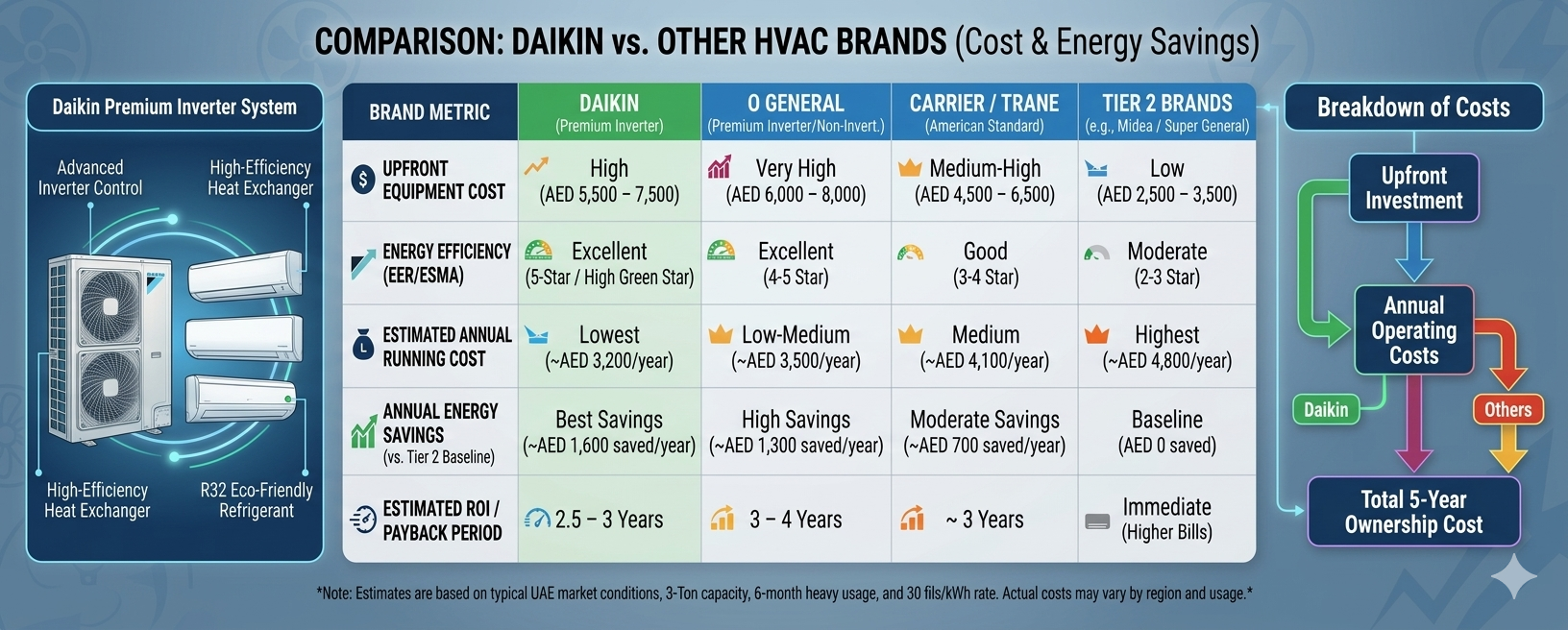
Invention and Mastery of VRV Technology
Daikin invented Variable Refrigerant Volume (VRV) technology in the 1980s. This multi-split commercial architecture allows an entire building to pull from a centralized system while providing highly localized, modular temperature zoning. It remains the gold standard for luxury villas, retail hubs, and commercial skyscrapers throughout the UAE.
Deep Infrastructure Investment in the UAE
Daikin does not just export to the region; it has embedded its infrastructure directly into the country.
-
- Jafza Headquarters: Daikin operates a massive 22,000-square-meter facility in the Jebel Ali Free Zone (Jafza) in Dubai.
- Localized Assets: This central hub houses an air-conditioned AHU (Air Handling Unit) factory, a comprehensive parts warehouse, and a dedicated Training Academy to certify local technicians and mechanical contractors.
Strong Air Purification Compliance
Dust storms and high ambient humidity can severely degrade indoor air quality (IAQ) in UAE. Daikin units feature premium air filtration systems that are globally accredited (including recognition by programs like the National Asthma Council) for efficiently trapping fine desert dust, allergens, and airborne particles.
Daikin’s Three Core Systems, at a Glance
DX (Direct Expansion) split and ducted systems – the workhorse for villas, apartments, small offices and standalone shops. One outdoor unit typically serves one indoor unit or a small ducted zone.
VRV (Variable Refrigerant Volume) systems – Daikin’s own trademarked term for what the industry generically calls VRF. A single outdoor unit can serve up to 64 indoor units, each controlled independently. This is the system of choice for high-rise towers and large size villas.
Chillers – centralized plants that cool water or a refrigerant fluid, which is then piped to air handling units across a building. Built for very large footprints like malls, hospitals and mixed-use high-rises.
Daikin DX Systems: The Right Fit for Villas and Standalone Buildings
For most UAE villas and smaller commercial units, Daikin DX split and ducted systems remain the most practical choice. A single outdoor condensing unit connects directly to one or more indoor units, delivering fast, straightforward cooling without the complexity of a centralized plant. Ducted DX systems in particular suit small to mid size villas well, distributing conditioned air through a single, professionally designed duct network so the whole home cools evenly rather than room by room.
The trade-off is flexibility at scale: DX systems work best when the building has a limited, well-defined number of zones. Once a project moves into multi-story towers or buildings with dozens of independently controlled spaces, VRV becomes the more efficient answer – which is exactly what we found on a recent villa project.
Vision Air project spotlight – Villa DX-to-VRV retrofit: A villa client came to us with an existing DX system, installed by another brand, that wasn’t delivering even cooling across every room and was running inefficiently. We removed the old DX equipment entirely and replaced it with Daikin VRV systems totalling 110 tons of cooling capacity across three systems. The result was consistent, room-by-room comfort throughout the villa alongside a meaningful improvement in energy efficiency – a good example of how VRV’s individual zone control can outperform conventional DX in larger, more complex homes.
Daikin VRV Systems: Built for High-Rise Living
Once a building goes vertical or if you have larger space, VRV is where Daikin’s engineering really shows its value. Because a single outdoor unit can serve up to 64 indoor units, VRV dramatically reduces the number of outdoor condensers a tower needs – a critical advantage when rooftop and façade space is limited and every riser has to be planned around structural and aesthetic constraints.
Each indoor unit in a VRV system draws only the refrigerant volume it needs at any given moment, so apartments or offices that are unoccupied or lightly used don’t drag down the efficiency of the whole system. Daikin’s heat recovery technology takes this further, allowing one outdoor unit to deliver heating and cooling simultaneously to different zones – useful in mixed-use towers where, for example, a shaded north-facing unit needs heat while a sun-facing unit next door needs cooling.
For residential towers specifically, Daikin’s Multi Tenant Kit solves a problem that used to make VRV harder to justify in apartment buildings: individual billing. Because multiple apartments can share the same outdoor unit, building management traditionally had no way to bill tenants for their actual usage. The Multi Tenant Kit meters consumption at each indoor unit, so management can bill every apartment based on what it actually uses – combining VRV’s space and efficiency advantages with the fair, unit-by-unit billing that owners associations expect.
Vision Air project spotlight – High-rise VRV installation: Vision Air recently completed a residential tower comprising 2 basement levels, ground floor and 8 upper floors, cooled entirely by Daikin VRV systems with a combined capacity of over 400 tons. The project included Daikin’s Multi Tenant Kit, giving building management the ability to bill each apartment individually for its cooling usage despite multiple units sharing common outdoor condensers. Throughout installation, the project received regular support and inspection from the Daikin team, ensuring the system was commissioned to manufacturer specification from day one.
Daikin Chillers: Cooling Malls and Large-Scale Developments
Malls, hospitals, hotels and large mixed-use developments have a different problem than towers: enormous, continuous cooling loads spread across huge floor plates, often running close to 24/7. This is where Daikin chillers take over. Rather than distributing refrigerant to dozens of individual indoor units, a chiller plant cools water (or a similar fluid) centrally, which is then circulated to air handling units throughout the building.
Daikin offers both air-cooled chillers, which reject heat directly to the atmosphere and need less plant room space, and water-cooled chillers, which use a cooling tower for more consistent performance regardless of outdoor conditions. Both configurations share the same core advantages for large developments: high energy efficiency at scale, long equipment life thanks to components housed indoors away from the elements, quiet operation with few moving parts, and the flexibility to size a plant precisely to a mall or campus’s real cooling demand. For facility managers, that combination of durability and predictable running costs is often the deciding factor over the building’s lifecycle, not just at installation.
Choosing the Right Daikin System for Your Project
As a general rule: DX suits small to mid sized villas and standalone units, VRV suits large size villas, multi-story residential and commercial towers where zone control and space efficiency matter, and chillers suit malls and very large developments with continuous, building-wide cooling loads. Many large mixed-use projects in the UAE actually combine more than one – chillers for common areas and retail, VRV for residential floors above.
Why Work With an Authorized Daikin Partner
Daikin’s high-ambient engineering only delivers on its promise when a system is sized, installed and commissioned correctly. As an authorized Daikin provider in the UAE, Vision Air Technical Services LLC installs every system in line with Daikin’s manufacturer specifications, which protects both system performance and warranty coverage – something that’s much harder to guarantee with unauthorized installers.
As Vision Air Technical Services is an authorised service provider for Daikin, we also provide maintenance services post installation works. We undertake AMCs for DX and VRV units through the support of Daikin.
If you’re planning a new build, a retrofit, or simply want to know which Daikin system fits your building, contact Vision Air for a consultation.